

The remarkable trees walk - Waharday
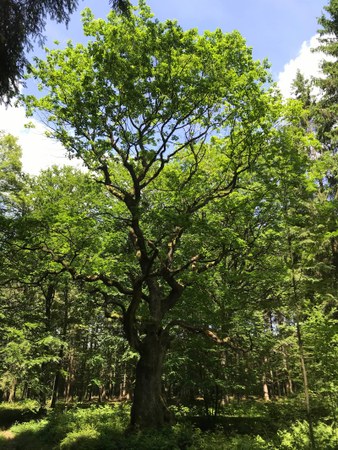
The Remarkable Trees Walk was created in 1999. Between 2021 and 2024 various boards and educational sites were added under the remit of the BiodiverCité project led by the Commune of Rendeux.
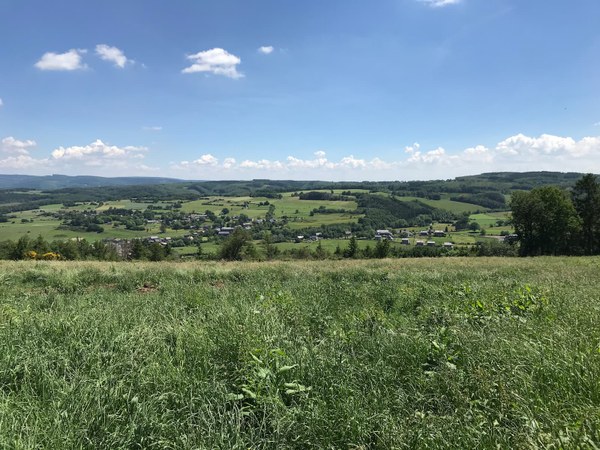
Although some of the historic trees have deteriorated over time, you can still enjoy the beauty of the surrounding scenery and nature, as well as the peace and quiet of the forest, over a stretch of several kilometres.
Summary :
Presentation of the walk
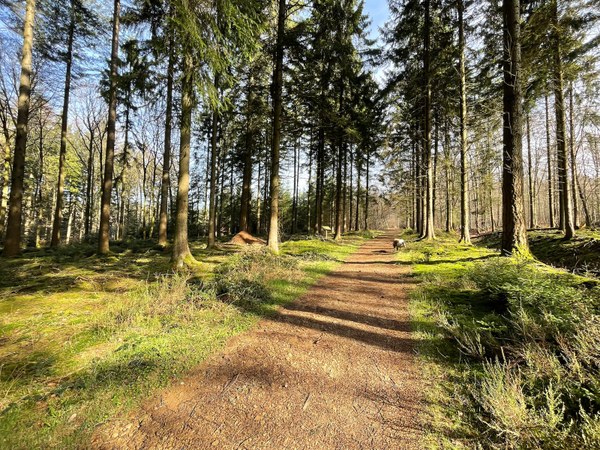
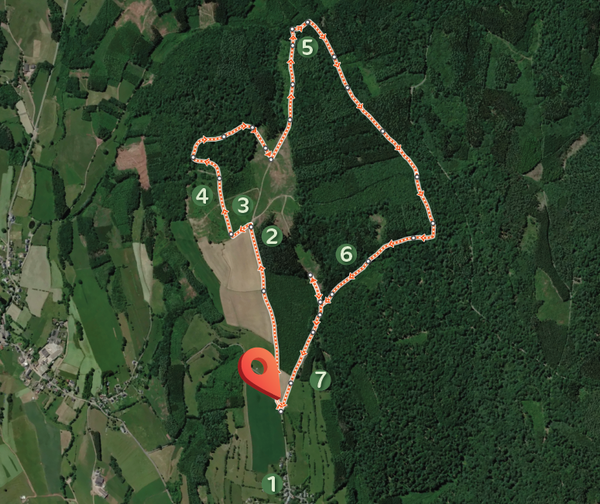
The remarkable trees walk is an “easy” walk, with around 100 meters of elevation gain and 5,750 km long. The only difficulty may be that it is relatively muddy in rainy weather.
Follow the yellow rectangle markings - RD7. Estimated time: between 1h30 and 2h depending on age, level and interest in the educational panels.
1. Linden Tree Avenue
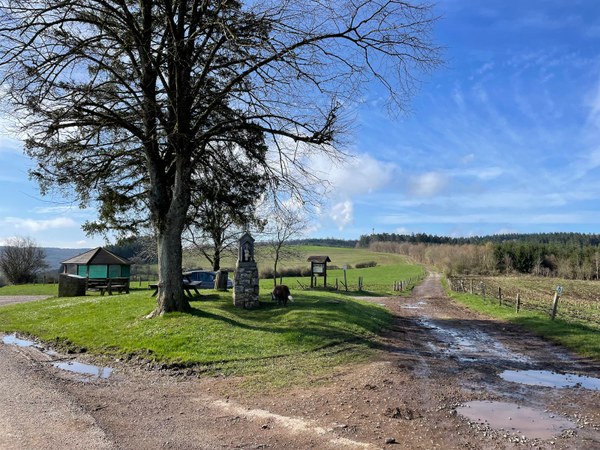
Between the exit from the village of Waharday and the kiosk where you are standing, you'll discover an avenue of around fifteen linden trees, some dating from the 1960s and others that were planted in 2023.
2. Copper Beech Avenue
Planted over a period of ten years since 2007, this line of copper beech trees reveals its full charm in autumn, when the leaves, which are usually chocolate purple in colour, turn a coppery red.
3. Natural regeneration zone
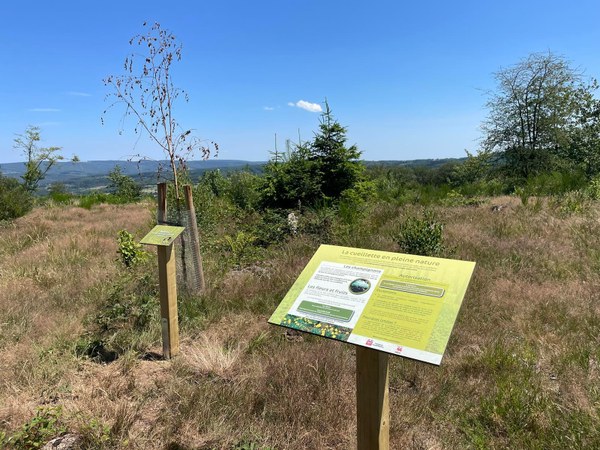
Here, take a look at the information board to discover the role of forestry officials and what happens to nature without the intervention of man.
4 - Gourmet Avenue
On your left, you’ll discover a 350 metre line of trees, most of which were planted in 2023 and all of which are destined for human or animal consumption. There's also an information board with tips on wild foraging. For more information, scan the QR code below.
5. Remarkable Trees
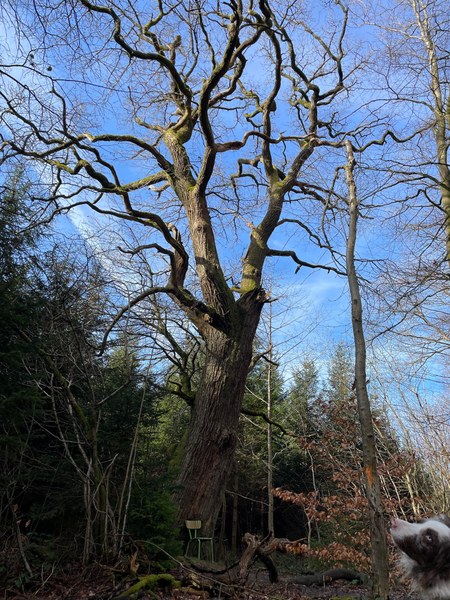
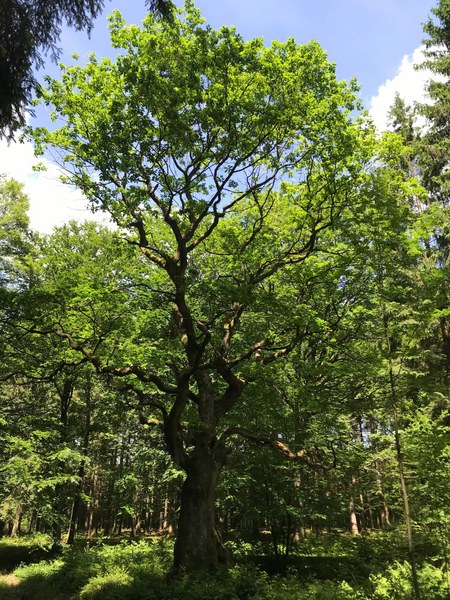
As soon as you enter the forest, you'll discover some extraordinary trees. Some are now suffering from old age, while others are in the prime of their lives or standing proud on the verge of greatness. A number of information boards are displayed: the characteristics of remarkable trees, their history, the life of a tree and anthills, which you will also discover close to the path.
6. Forest Pond
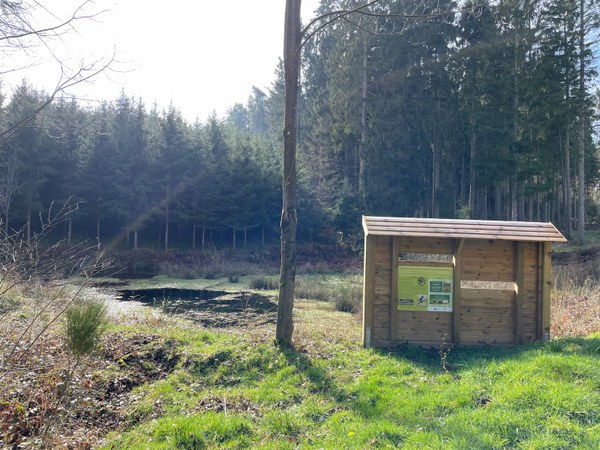
Take a short detour to the right (300m round trip) and you will come across a forest pond that you can walk around. An observatory and an information board provide more information about the flora and wildlife found in the pond.
7. Forest Arboretum
To finish off your walk, make sure you visit the forest arboretum where you can learn to recognise local species. An information panel will also tell you more about the flora and fauna to be found in the forest.
See a description of the path to take, via www.ardennebelge.be
The educational boards
"Flora and fauna of the forest pond" board
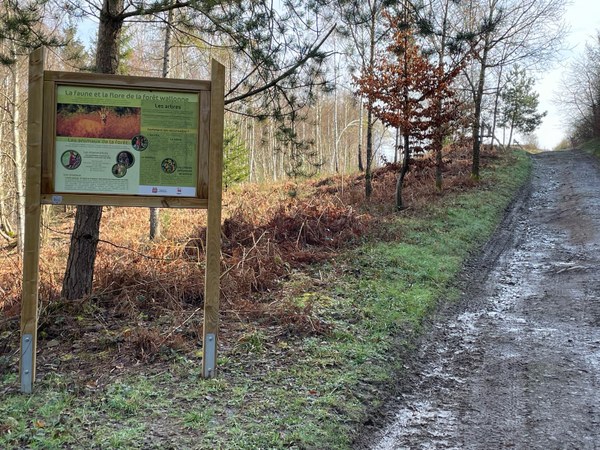
"Flora and fauna of the Walloon forest" board
“Natural Regeneration” information board
Every tree in the forest bears fruit at some time during the year. Inside the fruit are seeds. A pine cone, for example, contains 2 seeds behind each fin. The oak tree bears acorns at the end of its slender branches, the beech tree bears beechnuts, while the maple tree bears samaras.
If a number of conditions are met, these different seeds will germinate, grow and become first seedlings, then saplings, and finally trees.
This process is called natural regeneration. This regeneration process provided by nature is free and helps to regenerate the forest. It generally works quite well but is dependent on a number of criteria, such as: the amount of light on the ground, humidity, the presence or absence of invasive vegetation (such as bracken or bramble), and the presence of animals such as wild boar, which feed on acorns and beechnuts. Forest managers sometimes have to provide a helping hand to allow things to develop. For example, they might cut down trees to allow more light through to the ground, or they might install fences to protect the seeds from hungry animals. This natural regeneration can take place on a foot by foot basis, or when it is working well, we might observe patches of natural seedlings that cover the ground over several acres.
The role of a forest ranger
Public woods (woods belonging to communes, the region, CPAS, etc.) are managed by the Nature and Forestry Department (Département Nature et Forêt – DNF). This department is made up of many people, including forest rangers.
Each ranger has a defined area (territory) in which they manage the public forests. It is the forest ranger who designates the trees to be cut (swaging), the locations and species (tree species) to be replanted, the work to be carried out in the woods, such as pruning, clearance, path maintenance, maintenance of plantations, or more specialist work such as the creation of ponds, an arboretum, etc.
The forest ranger, as his title would suggest, also takes on the role of guarding/protecting the forest, enforcing a number of laws such as the Forestry Code (a law governing what can and cannot be done in the forest), the Nature Conservation Act, the Fishing and Hunting Act and others such as regulations on waste and on remarkable trees, etc.
See the board in French - "La régénération naturelle et le rôle des agents forestiers"
“Gourmet Avenue” information board
Welcome to “Gourmet Avenue”. Spread over approximately 350 metres on your left, you'll discover more than 20 species of trees renowned for their taste, pollen-making abilities, or medicinal qualities. Whether eaten at the table, by birds and other animals, or used in herbal teas and dietary supplements, they all have undeniable benefits for biodiversity.
- Plum - Prunus altesse double
The Altesse Double plum tree blooms in April and May with white flowers. It produces many small oval dark blue/purple fruits with firm yellow flesh. Harvesting takes place at the end of August.
- Plum - Prunus Belle de Louvain
The Belle de Louvain plum tree is a very good pollinator, with abundant flowering. The fruit, harvested in late August, is large, with juicy yellow flesh.
- Cherry - Prunus avium Bigarreau Napoléon
The Bigarreau Napoléon cherry tree produces large, heart-shaped, red/yellow fruit. Harvesting takes place at the end of June.
- Cherry - Prunus avium Burlat
The Burlat cherry tree is known for producing the first cherries of the year, as early as mid-May. Fruits are large and dark red, with a firm, sweet flesh.
- Apple - Malus domestica Jonagold
The Jonagold apple tree is very productive. Apples are medium-sized, pale red and yellow in colour, and have a crisp, juicy yellow flesh. Harvesting takes place in October.
- Apple - Malus domestica rode Boskoop
A very old variety, the Boskoop apple tree produces yellow and red fruit with a tangy flesh. This apples store very well (until March-April) and is harvested in September/October.
- Pear - Pyrus communis Conference
The conference pear tree produces an elongated, teardrop-shaped pear, which is light green in colour with brown marbling. The flesh is juicy and firm. It is harvested in October.
- Pear - Pyrus communis Doyenne du Comice
An old-fashioned variety, the Doyenne de Comice pear grows to a large to very large size, and has very juicy, whitish flesh. Harvesting takes place in late September, but the fruit is fragile and doesn't store well.
- Plum - Prunus domestica Victoria
The Victoria plum tree produces large red/purple fruits with a yellow background. The flesh is firm and yellow. Harvesting takes place in early September.
- Plum - Prunus domestica ‘Reine Claude d'Oullins’
An ancient variety, the Reine Claude d'Oullins plum tree produces medium-sized, greenish-yellow fruit. The variety ripens irregularly from late July to August.
- Medlar - Mespilus germanica
The medlar is a beautiful ornamental tree, but it also produces sweet seeded fruit that is eaten ripe (after the first frost).
- Birch - Betula pendula symbole verruca
Birch sap (or birch water) is well known for its many benefits: detoxing, joint relief, rehydration, skin and hair care, and more. You can also drink infusions of birch leaves, or extracts from its buds (called catkins).
- Small-leaved lime - Tilia cordata
Also known as infusion lime, the small-leaved lime (or small-leaved linden tree) blooms in July. Flowers are harvested over 2 to 3 days at the start of the flowering season when there are still a few closed buds. They are then dried for use in herbal teas, where they can assist with getting a good night's sleep and improving circulation.
- Large-leaved lime - Tilia platyphyllos
Lime blossoms can be consumed as an infusion, but there are also health benefits associated with other parts of the tree. The red sapwood (the part between the wood and the bark) promotes drainage of the kidney and liver and has choleretic, antispasmodic and vasodilatory properties. It is used to treat hepatobiliary disorders and soothe migraines.
- Wild Cherry - Prunus avium
The wild cherry (or sweet cherry) tree is particularly well known for providing treats for birds. However, the cherries are edible and are used to make kirsch (although they are too bitter for human consumption).
- Cornelian Cherry - Cornus mas
The cornel or cornelian cherry tree grows edible fruit, the dogwood berry, which can be eaten fresh when picked directly from the tree, but can also be used to make jams, jellies, juices, liqueurs, etc. Roasted dogwood berries can actually be used as a substitute for coffee beans.
- Pear - Pyrus calleryana Chanticleer
An ornamental pear tree, Pyrus Chanticleer is known for its pyramidal shape, reaching an average height of 12 metres. This variety attracts many pollinators and in autumn they take on a magnificent yellow-orange colour. The small brownish ovoid pears (1cm in diameter) are particularly attractive to birds.
- Apple - Malu domestica Radoux
The Radoux apple tree is a variety native to the Liège region. The apples are medium-sized and red in colour, and make a particularly good addition to the fruit bowl. They ripen in early October and can be kept until late November.
- Apple - Malu domestica Godivert
The Godivert apple tree produces medium to large apples that are green-yellow or red in colour. Its fruit, which is ripe at the end of October, is perfect for cooking (especially for making compote) and can be kept until April-May.
- Blackthorn - Prunus spinosa
Also known as sloe, blackthorn forms a very thorny bush that is particularly attractive to pollinators. Its fruits, the sloes, grow to between 6mm and 15mm in diameter and are purple/blue to black in colour. They are bitter in taste until they have undergone the first frosts. They are traditionally used to make local spirits.
- Horse chestnut - Aesculus hippocastanum
The fruit of the horse chestnut tree, known as a conker, is enclosed in a spiky husk. These are not to be confused with chestnuts, which can be eaten hot and roasted, and which are frequently sold in markets. True conkers are poisonous. The bark of the tree, however, is rich in tannins and flavonoids and is used in preparations for blood circulation problems.
- Guelder Rose - Viburnum opulus
A shrub that flowers from May to July, the guelder rose produces small red berries that are inedible raw, but can be cooked and used to make coulis, jams or jellies. They are also used in traditional medicine for digestive problems (antispasmodic) and have antioxidant, antimicrobial and analgesic benefits, among others.
- Rowan - Sorbus aucuparia
As the French name of ‘Sorbier des Oiseleurs’ suggests, mountain ash or rowan is particularly popular with birds. Its fruits, which are also known as sorb apples, are non-toxic (except when eaten raw and in large quantities) but are particularly bitter. Wafter cooking them for a long time, however, they can be used to make sweet and sour sauces, chutneys, jellies or jams. They are also known for their diuretic properties.
- Crab apple - Malus sylvestris
The wild apple tree or crab apple is sometimes used as rootstock for domestic apple trees. It produces small, yellow-green apples that taste acidic but become sweeter after the autumnal frosts, which is when they are often made into jellies or jams.
- Alder Buckthorn - Rhamnus frangula
Alder buckthorn is particularly well known in phytotherapy for its medicinal properties. Its bark and young twigs have laxative, digestive, antioxidant and anti-inflammatory properties. Its fruits, however, are poisonous.
See the board in French - L'allée "gourmande"
“Wild Foraging” information board
Many walkers like to enjoy foraging while they go hiking. While completely understandable and fun, it is only permitted as long as it remains within acceptable limits, i.e. foraging for personal use only.
Mushrooms
Mushroom picking is all the rage in autumn and Wallonia is home to over 9,000 species. When it comes to authorised quantities, each person is allowed to take a ten litre bucket of mushrooms per day, but it’s important to make sure you are accompanied by a good guide or that you have sufficient knowledge of what you are picking!
Flowers and fruit
In spring and summer, certain flowers (daffodils, lilies of the valley, wild garlic, etc.) and woodland fruits (blackberries, blueberries, etc.) become very popular with walkers. The Forestry Code authorises the picking of small quantities of these, but always on a not-for-profit basis:
- for flowers, two bunches per person per day;
- for berries, the equivalent of a 10 litre bucket maximum, per day and per person.
Picking and foraging is limited to the above-ground parts of plants (it is not permitted to dig up bulbs).
Authorisation
All forests have an owner and you will need their permission before you go foraging. In Rendeux, for example, only local residents in the commune and those with a secondary residence in the commune can pick items.
Exceptions:
- It is prohibited to pick fully protected plant species;
- Picking permits are valid between sunrise and sunset. This permit is suspended during the hunting season during the hours of stalking, the day before and the days of the hunt; information about this is posted at the main entrances to the communal woods.
It is only possible to leave the paths, tracks and roads within the woods for the purposes of foraging if you are on foot you must remain within a maximum distance of 50 m from the centre of the route.
Why are there restrictions?
Regulations on picking and foraging are simply intended to avoid mass, systematic harvesting, which is often for commercial purposes and could have a significant impact on the flora and wildlife in our forests: excessive trampling of the soil, fewer food resources for animals, hindering the development of species, etc.
Thank you for your cooperation!
Sources:
By-law on foraging and picking in communal woods (Rendeux) - Council meeting of 12/05/2020
‘Forêts de chez nous’ [Our Forests] - SPW Operational Directorate-General for Agriculture, Natural Resources and the Environment
See the board in French - "La cueillette en pleine nature"
“The Life of a Tree” information board
How a tree feeds
The roots absorb water and mineral salts from the soil. This ‘mineral’ water is transported to the leaves in the sapwood, just behind the bark. It's called raw sap.
Thanks to the sun's energy, the chlorophyll in the leaves transforms water, mineral salts and carbon dioxide from the air into sugars and releases oxygen. These light-absorbing pigments give leaves their green colour.
The nourishing sap (or elaborated sap) will nourish the whole tree, including leaves, fruit, wood and flowers. Whatever is not used, will be stored in the roots.
How a tree breathes
To live, trees must also breathe! They inhale oxygen and exhale carbon dioxide, just like we do! A tree breathes day and night.
To feed itself, the tree must also breathe backwards (photosynthesis), inhaling carbon dioxide and releasing oxygen into the air. However, it is seen as an ‘oxygen sink’ because it produces more oxygen than it consumes.
The tree also ‘sweats’ under the heat of the sun. When a tree suffers a severe drought, it will even go so far as to order its leaves to fall to the ground so that it can stop sweating and retain its water!
|
Did you know that a man consumes around 2,100 litres of oxygen in a day? Just one good-sized tree can produce all the oxygen a human needs for a lifetime! |
See the board in French - "La vie d'un arbre"
“Remarkable Trees” information board
According to the Regional Development Code (Code du Développement Territorial – CoDT), the following are deemed remarkable:
- trees and shrubs listed for their historical, landscape, dendrological (tree science), folkloric or religious interest, biological curiosity, exceptional size, or the fact that they constitute a geographical landmark;
>>> Rendeux boasts around 115 remarkable trees, shrubs and hedges on this official list, including more than 30 at the Robert Lenoir arboretum in Rendeux (the largest public arboretum in Wallonia) and approximately ten at the Château de Rendeux. In Wallonia, there are 25,000 in total.
- tall trees with a circumference of 1.50 m, standing 1.50 m from the ground as long as they are fully visible from any point within the public space.
Other categories are also eligible, such as high-stem fruit trees, shrubs, groups of trees or shrubs and hedges.
>>> Many trees and shrubs that are not (yet) on the official list are therefore also remarkable.
But just because a tree is remarkable, doesn't necessarily mean it's listed! Out of the 115 trees listed within the commune of Rendeux, only those to be found at the Saint Thibault Hermitage site in Marcourt are classified (there are two large-leaf linden trees at the foot of the stairs on the Bute du Calvaire, with circumferences of 4.86m and 6.64m respectively).
These trees form part of our heritage and usually have a story to tell. And this is why they are protected by the Regional Development Code: felling, damaging the root system or altering the appearance of a tree, shrub or remarkable hedge is subject to planning permission. In addition, there are obligations to comply with in respect of preserving them and fines for non-compliance.
|
During this walk, you'll be able to admire many remarkable trees, particularly from this point onwards, as you go down a superb line of trees stretching onwards for around two kilometres and dating back several centuries. Discover their story on the next information board. |
Source: https: //territoires.frw.be/
See the board in French - "Les arbres remarquables"
“Anthills” information board
Ants first appeared at the end of the Jurassic period (168 to 140 million years ago).
From the Arctic Circle, where some species can withstand temperatures as low as -40° Celsius, to the Sahara Desert, where others live at temperatures of over 70° Celsius, they have colonised almost the entire world.
Social organisation
Every ant has a specific role and sticks to it for the rest of its life!
- Workers have a number of roles. They build and furnish the nest, maintain the anthill and supply the nest with food, while also protecting and feeding other busy workers by regurgitating pre-digested food into their mouths.
- Some workers act exclusively as nannies, looking after the eggs until they hatch. They bring food to the larvae and look after them to ensure they have all the protection they need.
- Other workers act as soldiers, protecting the anthill from attackers such as insects.
- Male ants only have to worry about impregnating those ants that will become queens; these will move on to new anthills and are sometimes called “princesses”. The life of a male ant is not the most pleasant, however, since they only mate once and then die.
- The queen, however, is an adult reproductive ant who runs the anthill and lays up to a million eggs during her lifetime. She can live between 9 and 15 years and is the biggest ant in the colony.
Some ants have wings: these are often males, or queens who lose the wings after they have mated. These insects communicate with each other using pheromones. The (red) ant plays an essential role in the forest and is a protected species in Wallonia.
Habitat
There are two main types of anthills.
- Dome anthills: these are the ones that you see most frequently. Its vulnerability is essentially due to the fact that the nest is visible, which means it can easily be destroyed by walkers or animals. A domed anthill can be built from twigs, plant debris, resin, earth, sand and gravel, and in some cases even animal debris.
- An underground anthill: also common, this consists of numerous chambers dug into the earth by ants that excavate the soil, bringing it to the surface. These workers provide access to storage areas for eggs, pupae and larvae, as well as an area reserved for the queen. The ants gain access to these different areas via long tunnels.
A record was set in Brazil for a fungus ant nest that measured 8 metres deep and covered an area of 50 square metres.
|
Along the way, you can admire four (large) anthills, the oldest of which is thought to date back 25-30 years. < |
Sources:
https://blog.defi-ecologique.com/elevage-de-fourmis/
https://lemagdesanimaux.ouest-france.fr/dossier-222-fourmis.html
See the board in French - "Les fourmilières"
“A Brief History” information board
In the Middle Ages, our beautiful region was made up of areas of land that belonged to various vassals. These vassals relied on two major overlords – the Count of Luxembourg and the Prince-Bishop of Liège – who both fought over this hunting land.
It is highly likely that the trees you can see in this wonderful landscape were planted at this time to demarcate territorial boundaries. Today, they form the boundary between the communes of Rendeux, Hotton and Marche-en-Famenne.
From north to south, you'll still find many sumptuous oaks and beeches, the most historic of which are the Vierge du Fays Beech Tree and the Hambly Oak Tree.
|
The Vierge du Fays Beech houses a ‘potale’ (an alcove containing a statuette) affixed to the trunk of this venerated tree, inside of which can be found a statue of the Virgin. It is often decorated with flowers or candles. There are lots of different stories about the tree. The beech is said to have once been adorned with a cross, which the tree eventually absorbed. A statue of the Virgin Mary was put in place just before the Second World War by a troop of Boy Scouts visiting the area. During the war, the inhabitants of Chéoux and Waharday got into the habit of going there to pray for the prisoners. Abbé Gustin, parish priest of Chéoux, also celebrated mass there. Over the years, the old beech tree has lost most of its large branches, but it is certainly living out its last years in style. |
|
The Hambly Oak, which gave its name to the local area (a sign of its great age), is reputed to be at the point where the present-day communes of Hotton, Rendeux and Marche meet. Not far from there are the remains of a ‘croix d’occis’ [stone cross] bearing the inscription “Archange Guillaume de Favaigne a été tué le 2 septembre 1817 à l'âge de 24 ans” (“Archangel Guillaume de Favaigne was killed on 2 September 1817 at the age of 24”).
|
|
Marker trees Marker trees were once planted to mark a boundary (between territories, communes, etc.) or as a boundary marker for tree logging operations. |
Further on, you'll come to the source of the Houbompré stream, where you can also admire a superb hundred-year-old oak tree planted exactly at the site of the source. The latter, which never dries up, is quite strange as it gushes out just 30 metres from its highest point (at a place called "Aux Bruyères" - alt.395m).
Sources:
Arbres à Histoires – Mémoires de l’Ourthe – Editions Eole - 2001
See the board in French - "Un peu d'histoire"
“Flora and Fauna of the Forest Pond” information board
A pond is a shallow body of water that can reach a depth of around two metres, which generally allows all of the depths of water to be exposed to the sun's rays, meaning plants can take root all over the bottom.
Fed by rainwater and sometimes groundwater (below the surface of the soil), it can be linked to a system of ditches that allow water to flow in and out of it, acting as a type of buffer against run-off. It is sensitive to weather and climate variations and can therefore be temporary in nature.
Wildlife
Amphibians and dragonflies are two of the best-known groups.
|
Toads and frogs belong to the Anura class of amphibians. Their larvae develop in aquatic environments, in ponds and other stagnant water. This larva is known as a tadpole. Gradually, the tadpole develops its hind legs, then its front legs, and finally its tail. It is now ready to explore it’s land-based surroundings where it will spend most of his life. They only return to the water from time to time, during the breeding season. A toad's skin is much more pustular than that of a frog. It is also larger and stockier. Tritons and salamanders belong to the Urodela class of amphibians (i.e. they retain their tails as adults). Like frogs and toads, newts spend most of their lives out of the water: some people mistake them for little lizards! They are highly dependent on the aquatic environment for reproduction, and they spend a lot of time in the water during spring. The salamander, on the other hand, is a truly terrestrial species whose preferred habitat is the forest.>
|
|
A distinction must be made between true dragonflies and damselflies. Real dragonflies are bigger and fatter than damselflies. They never fold their wings over their backs, even when they are resting. By way of contrast, damselflies are smaller and much thinner than true dragonflies. Their wings are folded along their body when they are sitting. It takes several years for the larva to develop, but the adult animal only lives out of the water for a few days (from 5 to around 60, depending on the species).
|
Among reptiles, the grass snake depends on the amphibian populations it feeds on. Birds such as black storks, herons and kingfishers frequent forest pools, as do mammals such as water shrews and polecats.
Flora
Growing near the water you can find those plants that need a lot of moisture:
• Rushes grow in groups.
• The tall reeds produce spiky flowers in spring.
• The leaves on the sedge plant have edges so thin they cut through skin like razor blades!
• Irises have striking yellow flowers.
Some plants float on the surface of the pond, but their roots are fixed in the mud:
• Water buttercups,
• Yellow or white water lilies,
• Potamogetons float their oval leaves on the surface and flower in summer.
Other plants are completely immersed, i.e. underwater.
Finally, microscopic algae grow at the bottom of the pond.
Sources:
Guide sur la création de mares en milieu forestier V 1.1 (18/12/2012) - SPW Agriculture, Ressources naturelles et Environnement
https://www.saisons-vives.com/
See the board in French - "La faune et la flore de la mare forestière"
“Flora and Fauna of the Walloon Forest” information board
Trees, just like all plants, use photosynthesis. One cubic metre of wood can “trap” one tonne of carbon dioxide (CO2). In Wallonia, the forest captures 3.3 million tonnes of CO2 per year.
Trees
The proportion of tree species recorded in Wallonia is almost an even split between deciduous (53%) and coniferous (47%) species.
Spruce is the dominant softwood, followed by Douglas fir, pine, larch and other softwoods.
When it comes to hardwood species, we have: oaks, noble hardwoods such as beech, ash, maple, cherry, elm, and other hardwoods such as birch, hornbeam, willow, and more.
How can you identify them?
> Spruce
Its characteristic pyramidal shape with long, hanging cones makes it instantly recognisable. This tree can reach heights of 40 metres in Belgium.
> Larch
A magnificent conifer with light foliage (each needle is a leaf) and small cones. This is the only coniferous tree in Europe to shed its needles in winter, providing it with a light-green foliage in spring (when the leaves regrow) but a yellow-orange hue in autumn (like leaves on hardwood trees).
> Pedunculate and Sessile Oaks
These are distinguished by their morphological characteristics: acorns attached to the end of a long stalk on pedunculate oaks, and without a stalk on sessile oaks.
> Beech
This is a tree with a smooth trunk and glossy leaves, with fine hairs at the veins and around the edges. Its imposing stature, dense foliage and perfect adaptation to our climate make it the most dominant of our trees.
Forest Animals
The forest and its outer edges provide a habitat and breeding ground for a wide variety of animals. Between 30,000 and 35,000 species can be found in Wallonia.
Mammals
Around seven species of mammal live in our forests, from the smallest (red squirrels, grey dormice, foxes, etc.), to the largest (wild boar, deer, roe deer, etc.) and even bats!
Birds
Around 150 species of birds can be identified, many of which are frequent visitors to our forests. The large beech and oak forests are home to birds of prey (buzzards, sparrow hawks, falcons) and various species of woodpecker, which peck out cavities that will later be occupied by other birds (Tawny Owls or Boreal Owls). Stands of coniferous trees, all growing close to each other, are home to bullfinches, finches, tits, and more, while wagtails, dippers and kingfishers nest on the banks of the streams.
Sources:
‘Forêts de chez nous’ [Our Forests] - SPW Operational Directorate-General for Agriculture, Natural Resources and the Environment
See the board in French - "La faune et la flore de la forêt wallonne"